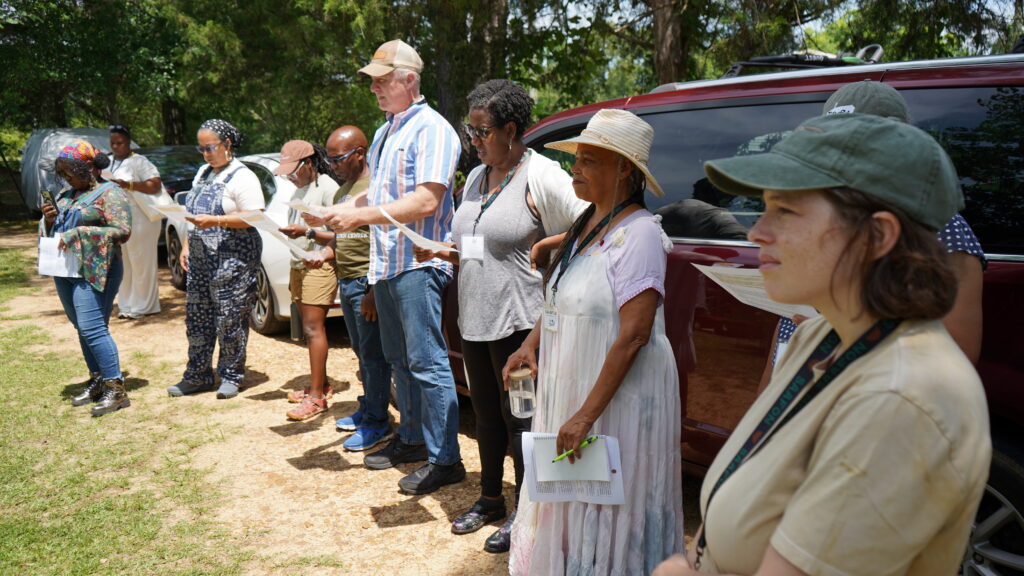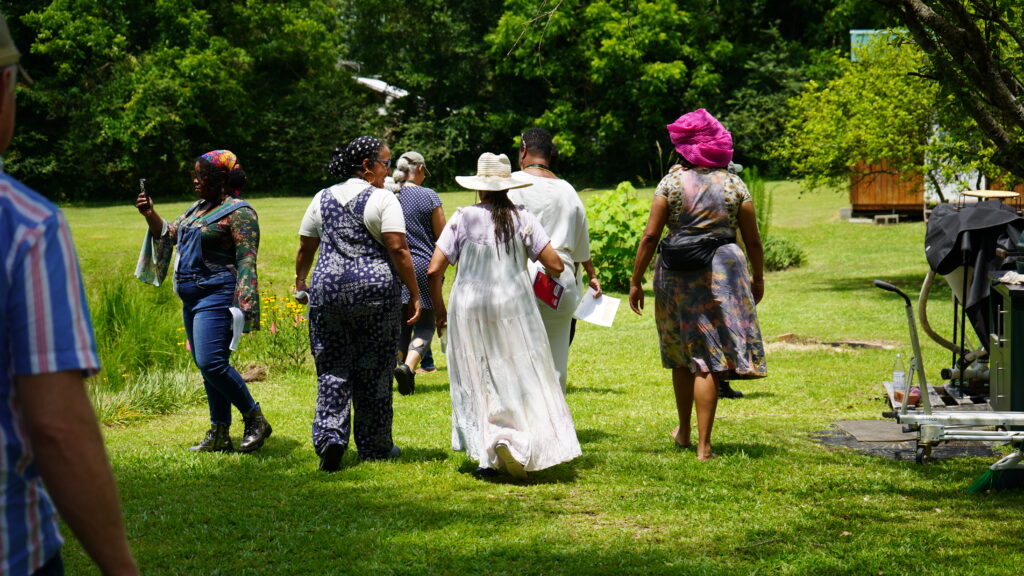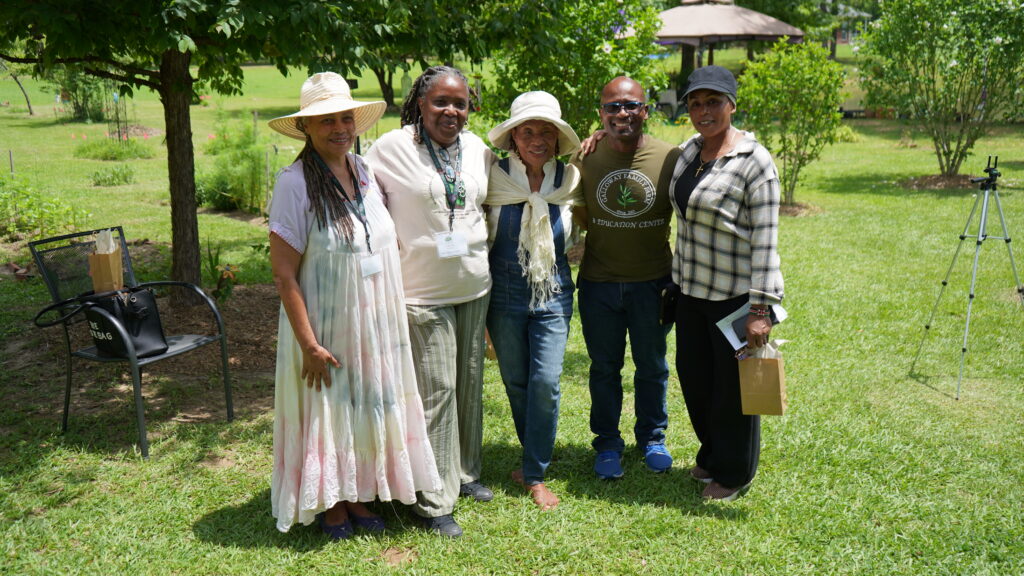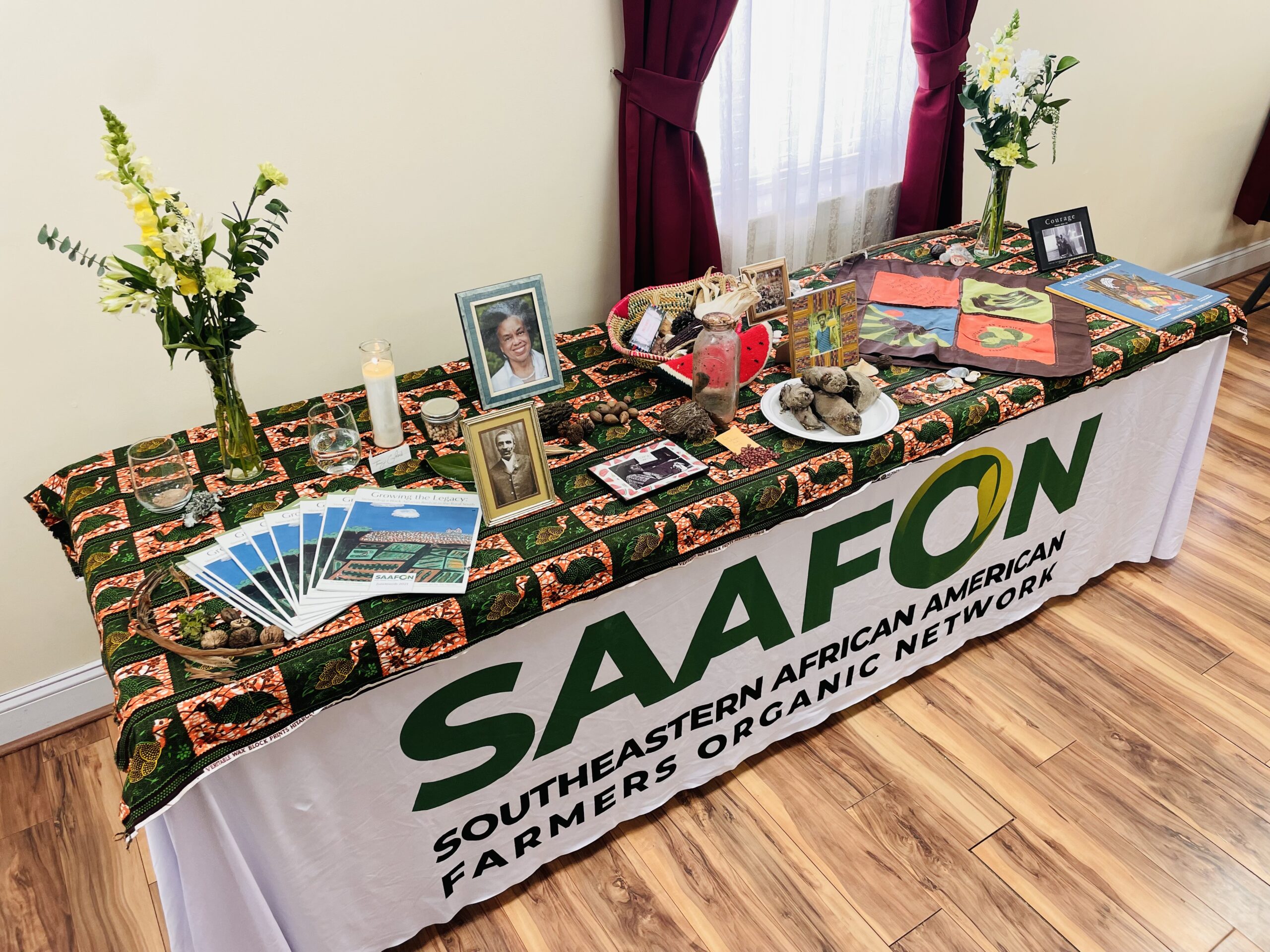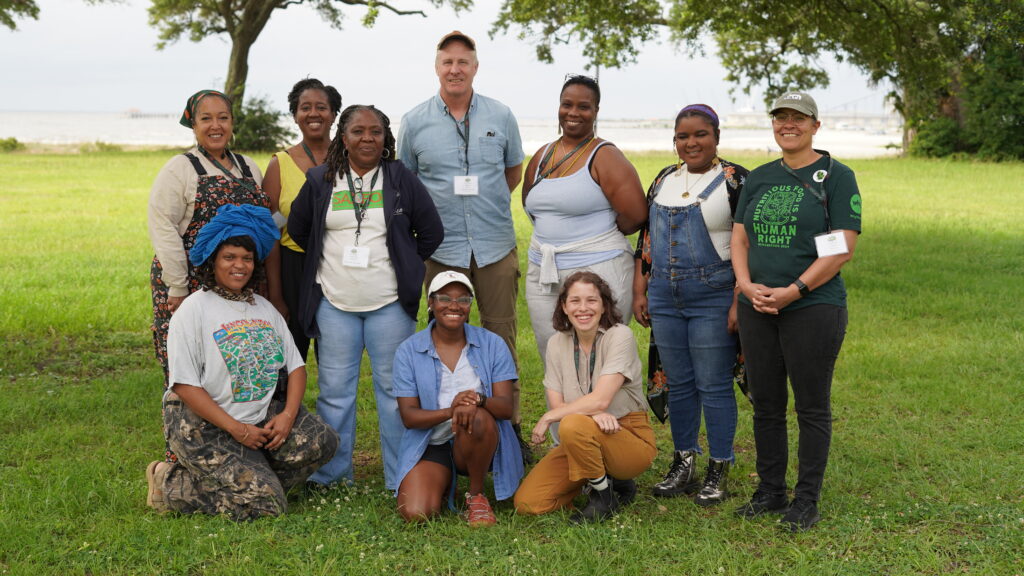
On June 2, 2026 thirteen SAAFON partners, board and staff members, and friends set out on a journey across the state of Mississippi to gain a deeper insight into the world of Black farming, particularly for small scale farmers across the U.S. South and Caribbean. The 2026 Agrarian Legacy Funder Education Tour – our second in 10 years – invited values-aligned philanthropic leaders and resource weavers to learn about what SAAFON calls the special alchemy of self determination, agrarian cultural values, continuity of tradition, nature appreciation, and thoroughly practiced resistance and resilience of Black agrarianism.
Funders across the agricultural and environmental justice landscape met SAAFON’s executive team and board members in Gulfport, Mississippi and traveled from the Gulf Coast up to the Mississippi hill country region of Waterford. Schmidt Family Foundation, WhyHunger, and Regenerative Agriculture Foundation representatives – all generous grantors over the years – met SAAFON members and learned about the joys and challenges of continuing in the legacies of their ancestors who maintained this land – many since the turn of the 19th Century.
Rose and Tracy Galloway hosted a beautiful three-course, farm-sourced meal – complete with offerings of sorrel hibiscus and shiso teas – following a robust tour of their one acre farm in Ocean Springs. More than 200 different trees are growing on their property where Tracy was raised as one of 17 children, with parents who instilled hard work and community preservation in communion with the land. Their daily family meals are sourced from Galloway Family Farm, where the Galloways raise chickens and turkeys in biodynamic infrastructure that supports humane care and processing. They offer community classes around produce and poultry farming, in addition to providing community-supported agriculture and youth education and empowerment programming.
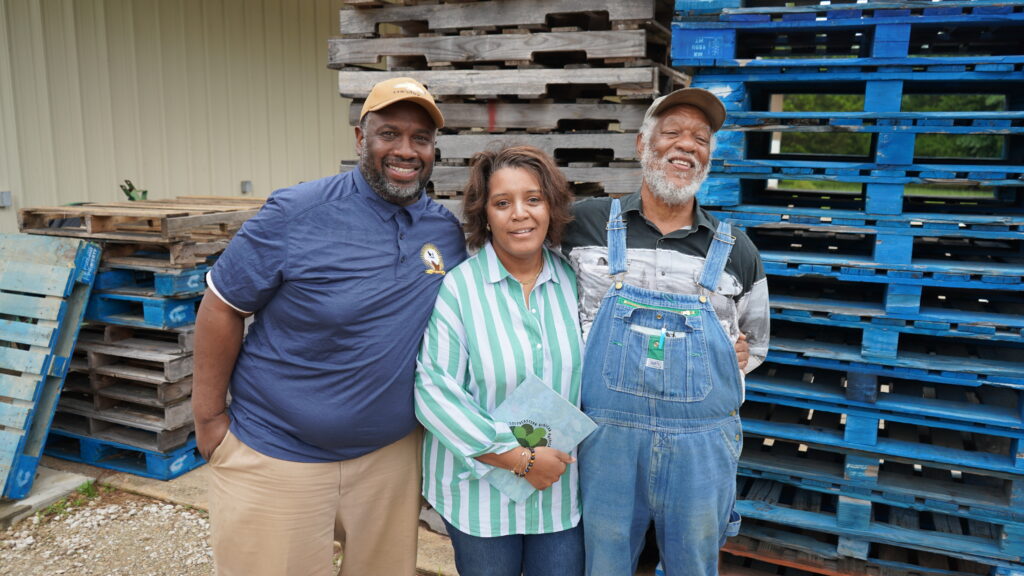
Ben Burkett, Jr., director of Indian Springs Farmers Association and state coordinator for the Mississippi Association of Cooperatives (MAC) within the Federation of Southern Cooperatives, hosted a tour of the packing house, followed by a hearty meal at the Sheeplo Community Center, in Petal. The packing center – with its threshing and sorting machines and multiple industrial refrigerators for beans, greens, squash, okra, and watermelon, to name a few – provides a production space and touchpoint for farmer members and community volunteers helping to sustain Indian Springs farmers’ market presence across the Mississippi Gulf Coast and New Orleans, and as far as the Midwest. Darnella Winston, Mr. Ben’s only daughter and MAC project coordinator, spoke of opportunities for growing relationships and cohesion within and across farmer coops in the unique face of rural Mississippi technology and broadband challenges.
SAAFON Board member Jesse Buie hosted our third farm visit on family land where he and several siblings maintain homes across 64 acres of 100-foot pine trees that he remembered planting as a young man in the 1940s. Mr. Buie’s certified production operation Ole Brook Organics, in Brookhaven, produces mixed vegetables, melons, turmeric and ginger, and is the site of his growing line of private-label products, including his USDA Certified Turmeric Powder, Sunflower Microgreens and Wheatgrass Shots. Under a climate controlled, glass enclosed pavilion on Mr. Buie’s campus, we learned about his work as board member of the Organic Farmers Association and the Real Organic Project – including the influential spaces he navigates on behalf of organic farmers – and we sampled a new product on its path to certification: Ole Brook Organics’ Turmeric and Ginger Wellness Shot.
As Day Two moved into late afternoon, Mr. Gary – our efficient and hospitable Cline motorcoach driver – drove us to the community farm managed by Mississippi Center for Cultural Arts (SIPP Culture) in Utica, as a part of a wrap around agrarian community development strategy that includes regular farmers market days for neighbors who desire fresh local food in a bedroom community that has persisted through historic economic disinvestment over several decades.
The weekly SIPP Culture farmers market takes place in front of Main Street Community Center, a brownfield site formerly used as an auto mechanic shop that has been masterfully refurbished through an extensive community human-centered design process led by co-directors Carlton and Brandi Turner. A down home Mississippi catfish dinner with an ample variety of locally sourced vegetables was prepared by the SIPP Culture kitchen crew from a modern, state-of-the-art commercial kitchen, which also feeds Friday night community “Karaoke with the Mayor” guests, and special community and family centered events. Several Agrarian Legacy Tour guests agreed, however, that the highlight of SIPP Culture’s trifold community impact strategy was visiting the beautiful Craftsman cottage where rural artists take residency for a variety of individual retreats and cohort collaborations through the Rural Performance Production Lab (RPPL) that support the incubation, production, and curation of artistic expression rooted in the histories, cultures, landscapes, and lived experiences of rural communities.
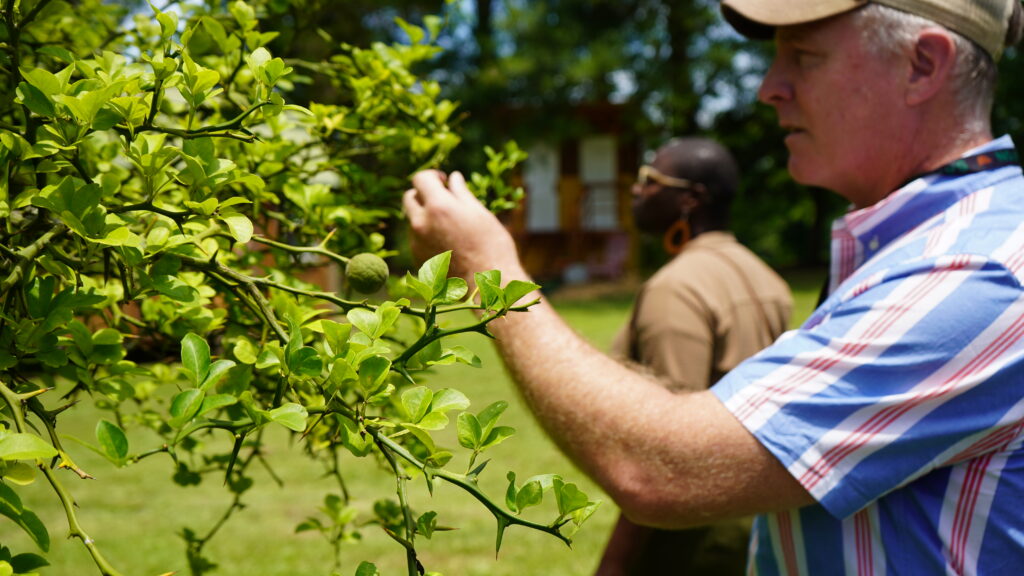
The final full day of the Agrarian Legacy Funder Education Tour began Thursday with an herb walk and tour with the inimitable Earcine Evans, owner and operator of Francis Flowers and Herbs Farm in Pickens. Participants got to see the impact of SAAFON’s role as an intermediary funder supporting farm operations with direct community impact across our 11-state and territory footprint. Mrs. Earcine led a heart-guided, head to sole walk across her seven-acre biodynamic farm, visiting with dozens of herbs and flowers as she paused the tour to discuss each plant’s medicinal value and healthwise inputs. As with our first visit at the Galloways’ in Gulfport on Tuesday, we were able to see some of the infrastructure projects that SAAFON donors helped to build, from farm storage spaces to compost toilets that guests employed with the sawdust provided! The agroecological and biodynamic practices Mrs. Earcine and her husband Mark use – including application of biodynamic compost tea – maintains an intentional diverse plant population that reduces pest pressure through ecological balance rather than chemical intervention. Many participants left the farm with value-added moisturizers, soaps, and tinctures.
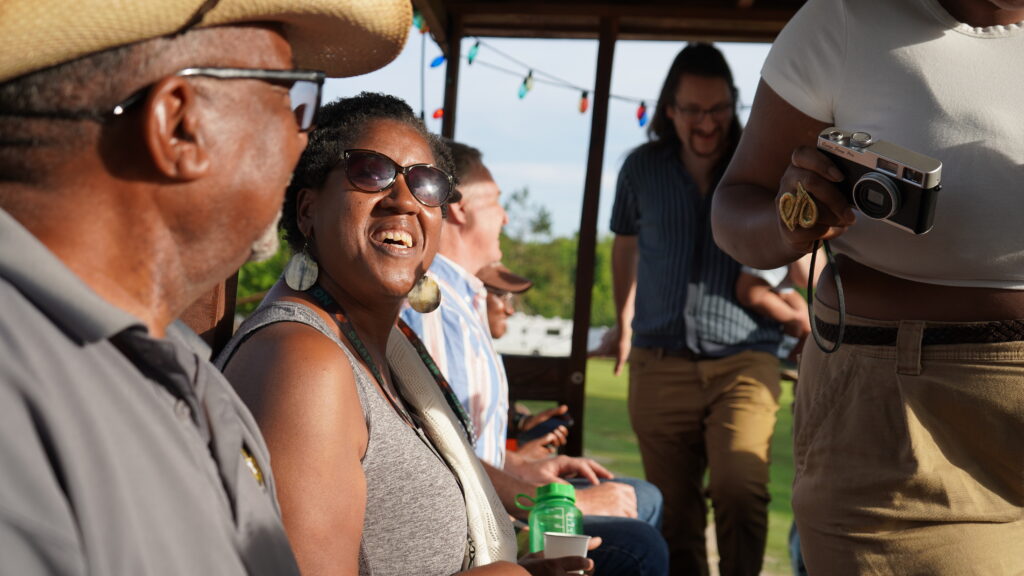
Our final visit to Foxfire Ranch in Waterford, just one hour south of the Memphis Airport where participants took flights home, tied a neat bow on a fully immersive Mississippi experience. The Hollowells – Mr. Bill, Mrs. Annie, and their daughter Annette – pulled together the history, journey, experience and regeneration of Black agrarian dreamweaving and manifestation over the centuries of honoring, acquiring, defending, maintaining and regenerating ecologically sustainable agricultural relationships to the land, air, water and all of their kin. On a 1950-something tractor trailer ride with friends young, middle aged, and elder, Annette set up the context of being raised with the ancestral assignment of perpetuating multi-generational Black-owned land legacy in the “Dark Corner” community of Marshall County. Eighty acres of unceded land that was eventually sold to her grandparents – adjacent to other properties sold to African Americans at the turn of the 20th Century because the area’s topography and soil quality were deemed undesirable – became a beacon of family pride, self sufficiency, through visionary planning, diligence and immeasurable sweat equity.
Rondalyn Pierce, a local historian, joined us to extend the context of Black woman landowning history in Mississippi, and alongside Ms. Annie’s world renowned spread of catfish, cornbread, greens and cobbler, we ended the night with a special blues concert by artist Lightnin’ Malcolm.
DEEPENING AND EXPANDING RELATIONSHIPS
“I love that the focus was not solely on production but on how farmers work on being together,” our Board chair Yvette Browne said. Mrs. Browne, Sejah Farm co-owner and operator in St. Croix, Virgin Islands, helped to bridge storytelling between our current organizing methodology and practices, and the early regional, national and international work of our SAAFON ancestors and co-founders Cynthia Hayes and Dr. Owusu Bandele. Mrs. Browne has helped to weave and grow the diasporic connections between Black farmers in the U.S. South and the Caribbean network of farmers who are SAAFON members.
“Many organizations say [we are here to serve our farmers] and then farmers look around wondering where they are. I am proud to say that is not the case with SAAFON. At the end of the day we must serve farmers and it was great to see the interaction and collaboration – it was so uplifting.” A handful of Tour hosts, and local farmers who remotely collaborate with them, followed the Agrarian Legacy caravan during different legs of the trip, not only to offer moral support to host farmers, but also to lay eyes on their colleagues and their family-stewarded operations from where they usually share best cultural and farming practices in Zoom squares.
“I had been wanting to come up here and see this farmer’s operation for a long time,” said one farmer member who followed the caravan to the two farm sites on Thursday.
“This family is doing exactly what I have been dreaming of doing with my property,” another farmer said. “Seeing their operation confirmed that it is all possible.”
Throughout the SAAFON Mississippi farms Tour, participants lodged at Black-owned and operated bed and breakfasts across the state, including The Almanett and Hotel Vela in Gulfport, Orchid Bed and Breakfast in Jackson, and Foxfire Ranch in Waterford.
Nearly 500 miles and four days wiser, funders and farmers alike said immediately following the Tour that the experience was both illuminating and transformative. An intimate cohort, 100% of the handful of funder representatives who attended rated the Tour excellent, well worth the investment of time and expense to attend, and igniting an increased understanding of the work, impact and opportunities in working with Southern Black Agrarian communities.
“I don’t think I understood the level of complexity and challenge that farmers face each day, while being resilient and hopeful about the future,” said Saint Allen Austin, a Mississippi native and the Tour’s documentarian.
For the Tour organizers, led by Co-Executive Directors Whitney Jaye and Alsie Parks, to hear our farmer members say that the event they helped to host also transformed them and expanded their dreamspace was incredible confirmation of the importance of this logistical stretch for a small but mighty SAAFON team.
“It felt important to complicate what people thought they knew about Mississippi. Our goal was to invite curiosity about the culture, people, land stories, and nuances – beyond the unchallenged narratives,” Whitney Jaye said.
With Mississippi myths busted and Black agrarian futures reimagined through investment, SAAFON considers our mission accomplished and instructive of our strategic development for visibilizing and resourcing small scale Black Southern and Caribbean farmers over the next twenty years, and beyond.
IT’S NOT TOO LATE TO GET ON THE PROVERBIAL BUS!
Our Team is beginning to think about a Tour recap that would illustrate how deep regional relationships support continuity and vitality of Black agrarian communities. If you would like a copy of the Funder Tour Booklet for more information about the itinerary and the farmers who hosted us, contact Alisha Johnson Perry at ajperry@saafon.org.
At this halfway mark of our 20th anniversary celebration – with the General Membership Assembly and Funder Education Tour behind us – we continue to welcome sponsorship gifts at our Give Lively site: https://secure.givelively.org/nonprofits/saafon/event-ticketing/saafon-agrarian-legacy-funder-education-tour-2026/event_details.